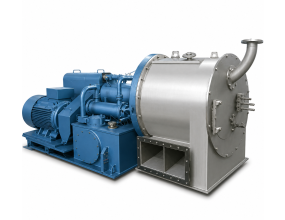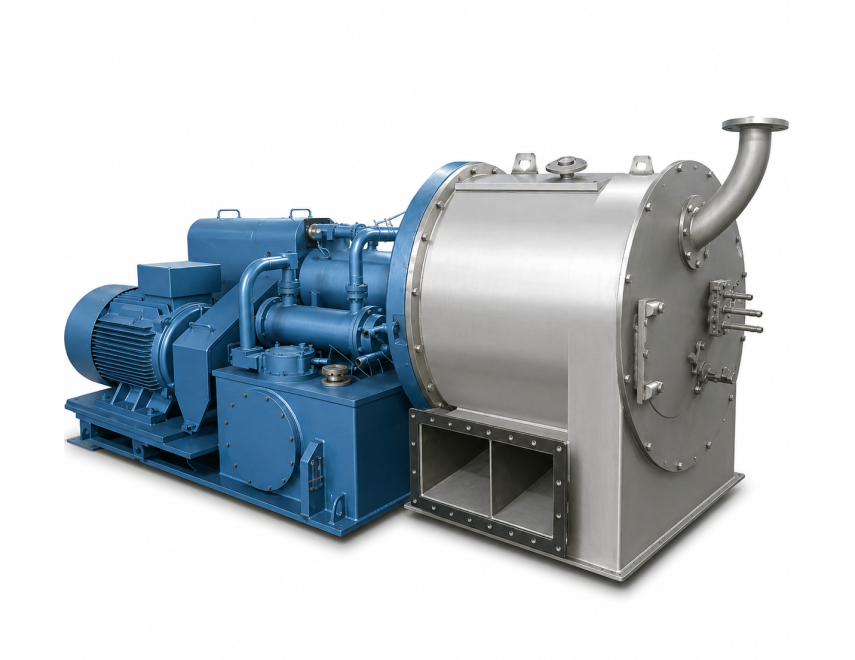
Pusher centrifuges are continuously operating filter centrifuges and can have several basket stages depending on the application. The solid-liquid separation shown here demonstrates a two-stage pusher centrifuge. Periodic rinsing of the process area is achieved by means of integrated rinsing nozzles and pipes.
Application:
Salts de-watering
Chemical Industry:
Chlorides, Sultphates, Chlorates, Ures, Sodium, Nitrates, Calcium.
Mineral process:
Salts, Photsphate, Postassium cloride.
Petrochemical Industry:
Adipic acid,
Output Capacity:
1 ton/hr - 100 t/hr
Principle operation of Pusher Centrifuges:
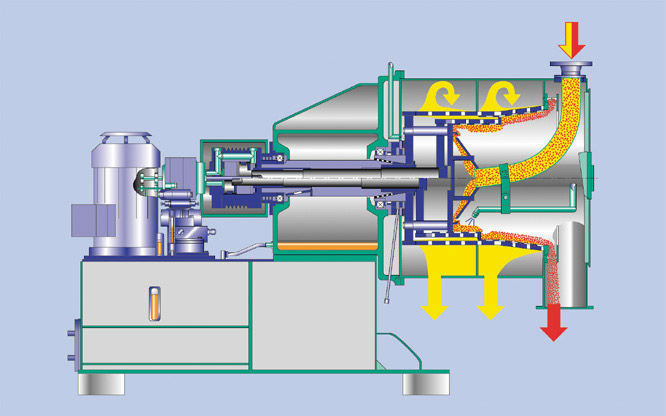
The pusher centrifuge continuously separates solids from liquids through two parallel mechanisms:
- Centrifugal filtration: The suspension slurry is continuously pumped into the rotating drum. Centrifugal force pushes the liquid through the filter screen and out. The solids are retained to form a cake layer.
- Continuous cake discharge: The piston reciprocates back and forth continuously. Each forward stroke pushes the cake layer progressively forward until it overflows into the discharge outlet.